

İnterior Designer
3D Laser Scanning and Measurement Technologies in Yacht Interior Projects
Accurate measurement is essential for successful yacht interior manufacturing and installation. With the precision provided by 3D laser scanning technology, design, production, and installation processes can be carried out with significantly reduced risk of errors.
Accurate measurement is one of the most critical stages of any yacht interior design and engineering project. Unlike conventional architectural spaces, yacht interiors often include curved surfaces, limited working areas, varying ceiling heights, and complex technical installations. For this reason, even minor measurement errors can lead to significant challenges during manufacturing and installation.
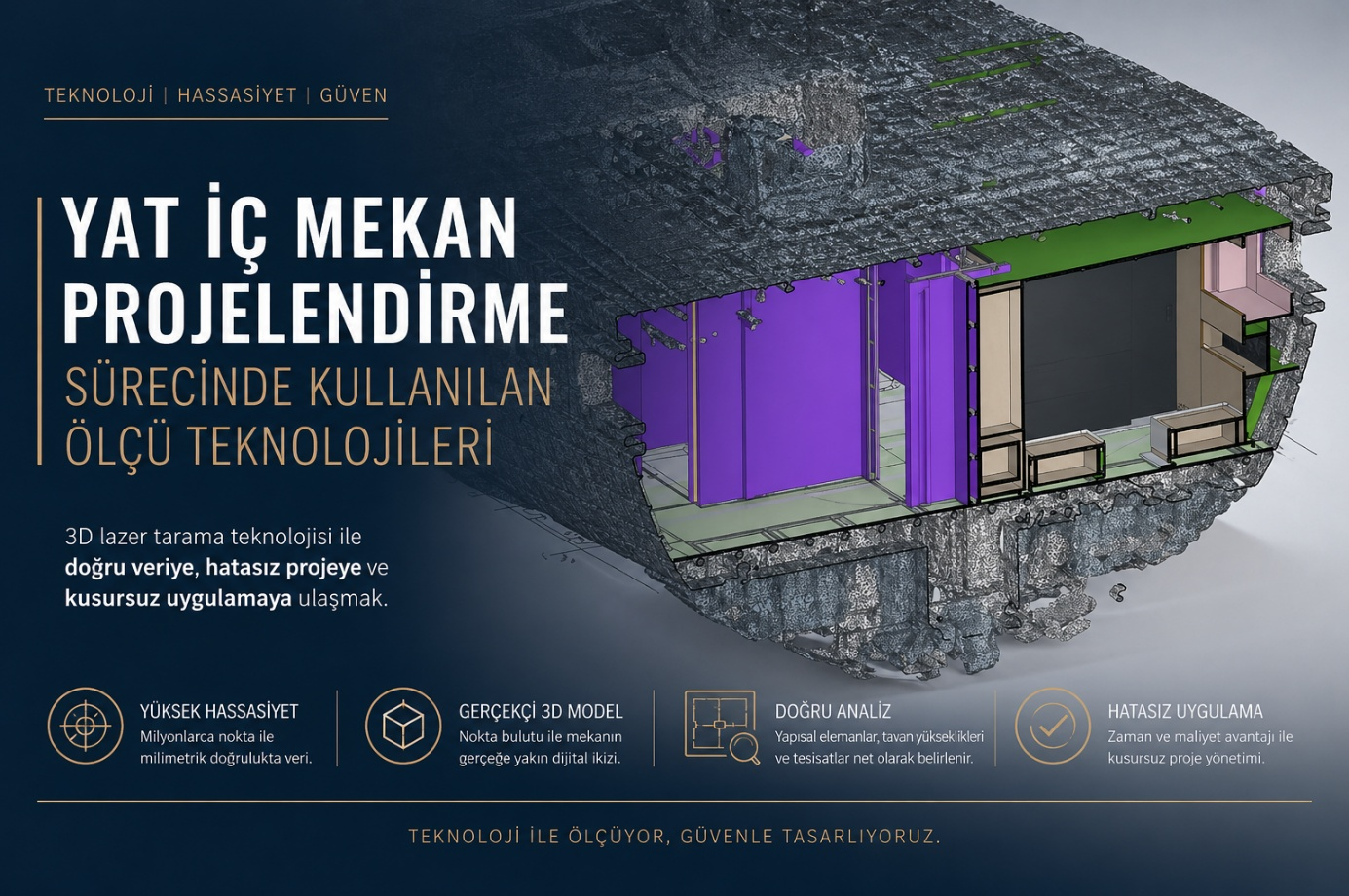
While manual measurement methods were widely used for many years, 3D laser scanning technology has become an essential tool for achieving greater accuracy and reliability. By scanning the existing environment, laser scanners capture millions of measurement points and generate a point cloud, creating a highly detailed digital representation of the space.
During the hull stage, careful preparation of the scanning environment plays an important role in data quality. When required, controlled lighting conditions are established and each area is scanned individually. This allows designers and engineers to accurately identify structural elements, ceiling clearances, technical systems, and other critical details before the design process begins.
The collected 3D scan data is then integrated into design and production workflows. Furniture layouts, panel connections, installation details, and service routes can be reviewed and coordinated before manufacturing starts. This approach is particularly valuable for refit projects and areas where existing dimensions may differ from original plans.
Without 3D scanning, projects rely heavily on manual measurements, increasing the risk of human error. Even small dimensional deviations can result in manufacturing discrepancies, installation difficulties, and the need for on-site modifications. These issues often lead to additional costs, project delays, and unnecessary rework.
In modern yacht interior projects, 3D laser scanning is no longer just a measurement tool; it has become an important part of the engineering and production process. By providing accurate site data from the beginning of a project, it helps reduce risks, improve coordination, and support a smoother transition from design to installation.