

Project Manager
What Do We Actually Miss When Everything Seems Right in a Project?
A project that starts with accurate data ensures a more controlled, efficient, and reliable process from design to production. With 3D scanning technology, details that could be overlooked during the site surveying stage can be detected and evaluated before production begins.
A project that starts with accurate data ensures that the entire process, from design to production, progresses in a more controlled, efficient, and reliable way.
Most of the time, what we miss is actually the data at the very beginning. In other words, how accurately the existing conditions have been interpreted. Because in order to make the right decisions in a project, we first need to have accurate data.
This initial step of the project actually forms the foundation of the entire process. It is the accurate reading of the existing conditions through measurement and documentation. This is where site surveying comes into play.
In the past, this process used to progress through hours of manual site survey work. Measurements were taken with a tape measure, notes were recorded, and details were documented one by one. However, no matter how carefully this method was carried out, there was always a risk of something being incomplete or overlooked. Especially in yacht projects, where every area within a limited volume must be used with maximum efficiency, every measurement directly affects the design decision. Even a small measurement error can lead to the entire layout being reconsidered in the later stages.
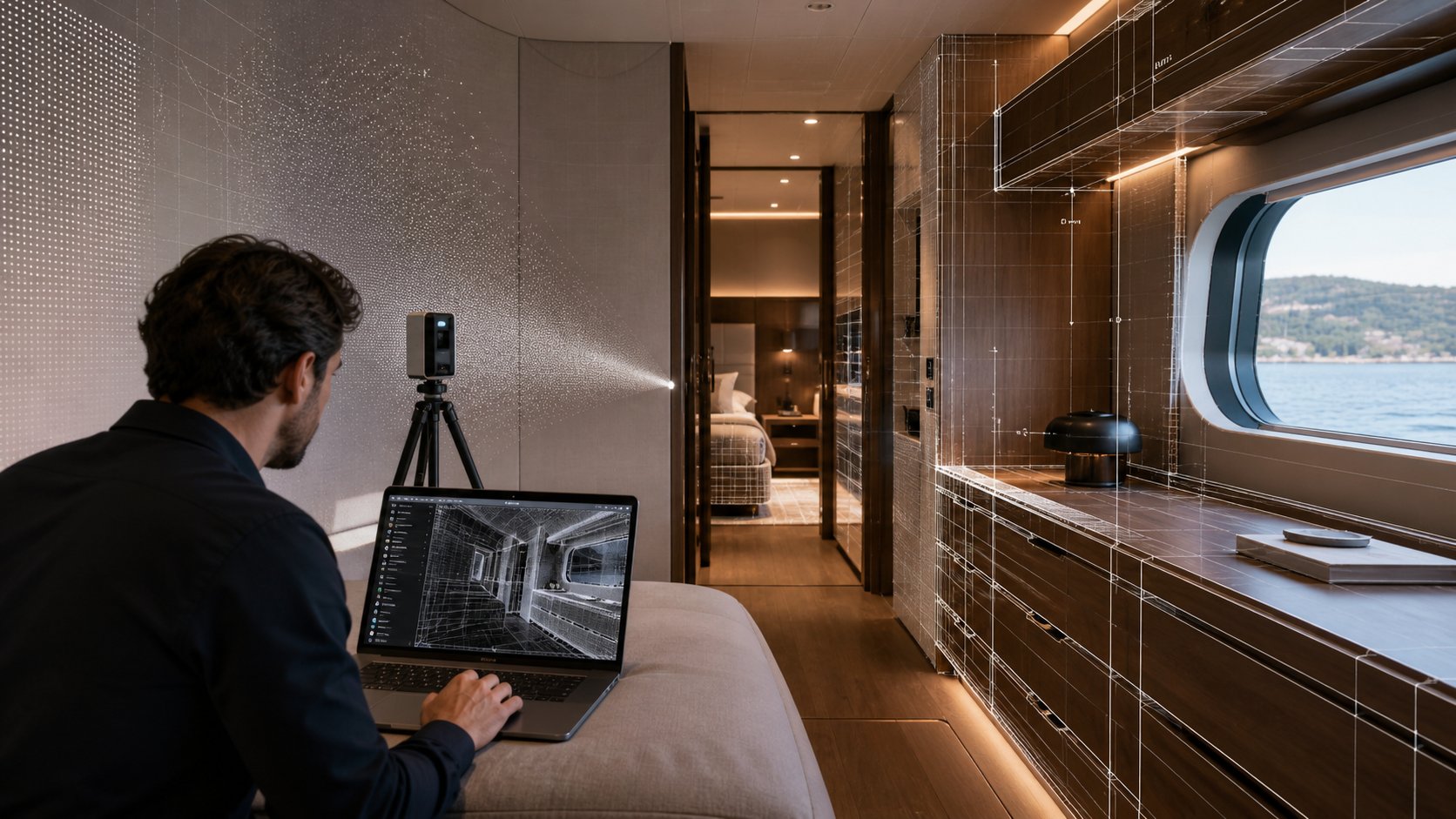
Today, however, we manage the site surveying process with the support of technology. Thanks to advanced 3D scanning systems, we can digitally scan the entire space down to the smallest detail. Now, we have not only measurements, but also an exact digital 3D representation of the space.
I can open this 3D model on my computer, measure any point I want, examine the details, check approach distances, and base my design decisions on a much more solid foundation. For example, details such as the opening distance of a cabinet or the actual usable width of a passage area can be clearly evaluated before moving into production. This allows me to notice and solve many problems that could have been missed at the very beginning of the process.
With 3D scanning, problems that could be overlooked at the start of a project are also eliminated.