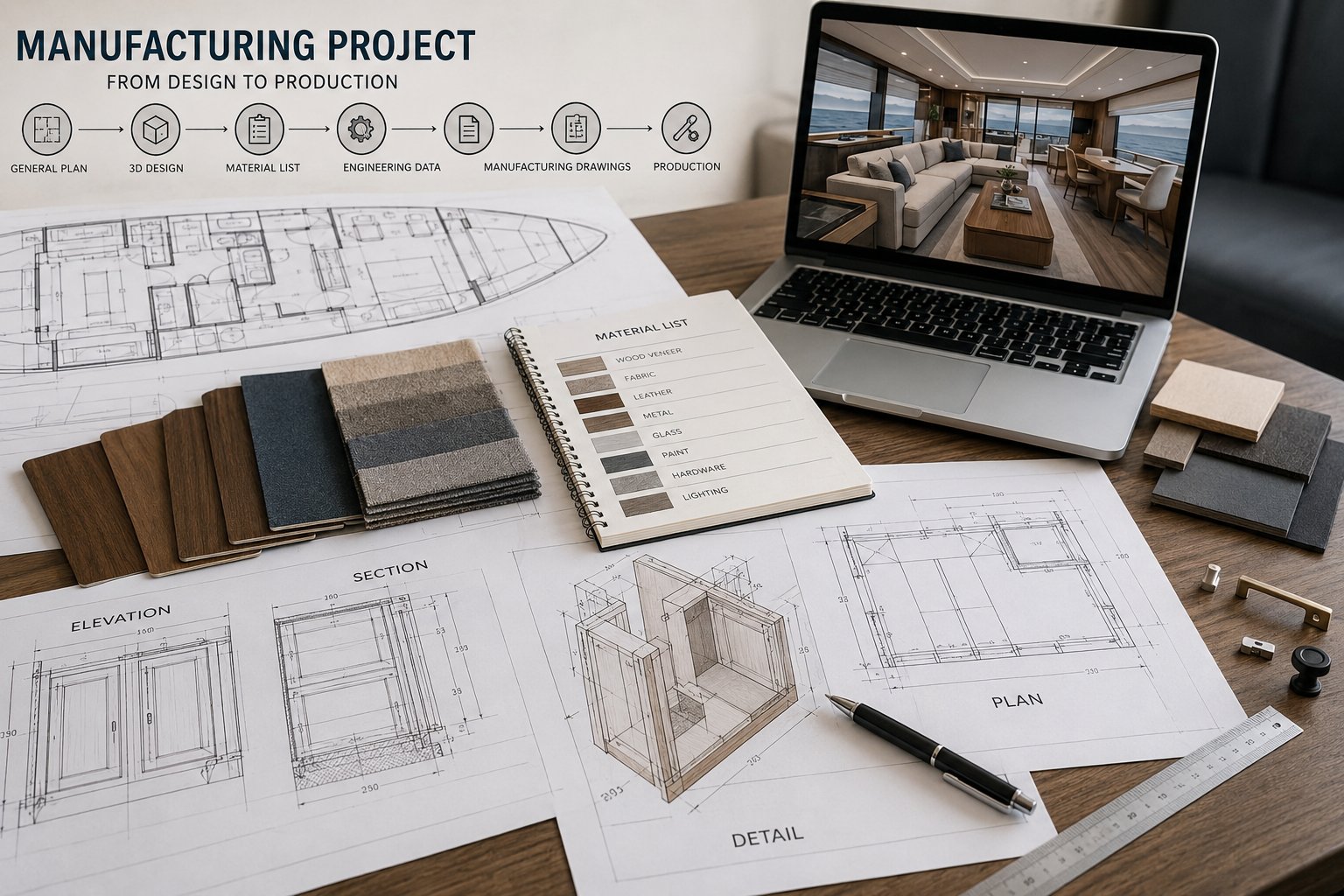
At the beginning of a project, the clean and accurate transfer of the data flow related to the project is one of the most important factors. We can summarize the content of this flow with the following main questions: What does a furniture manufacturer need when transforming a design project into a manufacturing project? Which information has priority? In what order should this information flow proceed? How can we trust the accuracy of the information? Now, let’s evaluate these main topics in more detail.
MAIN TOPICS NEEDED IN A MANUFACTURING PROJECT
GENERAL PLAN
The general plans approved by the client or the shipyard are very important in the first step. These plans show us the general layout, door positions, stair areas and cabin interior arrangements. With this layout, the working areas are determined and the scope of the work becomes clear.
DESIGN RENDER STUDIES
Approved visuals prepared by the designer are essential for creating manufacturing details. At this stage, the general concept of the design is understood. Surface finishes, decorative elements such as fabric, wallpaper, mirrors, glass, etc. help the project take shape in our minds and support its transformation into details.
2D-3D DESIGN MODEL
When the design project is delivered together with the design visuals, the process of transforming it into a manufacturing project begins. The important point here is that the topics mentioned in the previous sections remain consistent with each other. The general plan must match the model, and the model must match the visuals. This consistency provides a correct starting point.
PROJECT MATERIAL LISTS
While project details are being created, lists including fabric, leather, metal, paint-varnish, wood veneer, curtains, sanitary ware, devices, accessories, lighting fixtures, etc. help create the correct furniture details. Project management must provide these lists completely and accurately to ensure the proper flow.
ENGINEERING DATA
After these main topics, the need for more technical information begins to arise. These include plumbing plans, electrical plans, HVAC plans and details, fire escape plans, insulation plans and details, door plans, deck doors, etc. At this point, the work carried out by the engineering department under project management becomes important.
It is quite difficult to define a strict order here. Without insulation plans, wall plans cannot be created. Without HVAC details, furniture details cannot be finalized. Electrical plans affect ceiling plans, and pipe passages determine wall layouts.
SO, HOW CAN WE TRUST THIS INFORMATION?
The project draftsman who receives this data must first have a certain level of experience in what they are doing and must manage the questioning process correctly. They should evaluate each study, test its compatibility with furniture details, and integrate the provided information with their own manufacturing details to create an accurate project. Through this questioning process, the accuracy of the incoming data is also revealed.
The manufacturing project is shaped by all this technical information. A manufacturing project is not just a drawing that contains furniture details. It is the process of combining the design project with engineering data, detailing it correctly, and making the design producible.
The project is finalized with the approvals given by the shipyard management in light of this data and then enters the process of becoming reality. Thus, the imagined designs become a real and unique product through production.